
Will your song be turned down?
Drop in a WAV or MP3 of your mix or master. You see its loudness the way Spotify, Apple Music, YouTube and Tidal measure it, how much each one will turn it down or up, whether its peaks will distort once it is encoded, and where it clips. It is all measured here, on your device: your song is never uploaded.
Check a song
One question first, because the advice depends on it. Then the file: a WAV is best, and an MP3 works.
Measured here, in your browser. The song is never uploaded, and nothing is saved.
The reading
The numbers, every few seconds
What each service will do
Your fileHow it plays thereThe service's level
Levels as of October 27, 2026. Spotify publishes its own (Spotify for Artists, loudness normalization); Apple Music, YouTube and Tidal publish none, so theirs are what engineers measure. Any of them can change it: type a new level and every row follows.
What to do about it
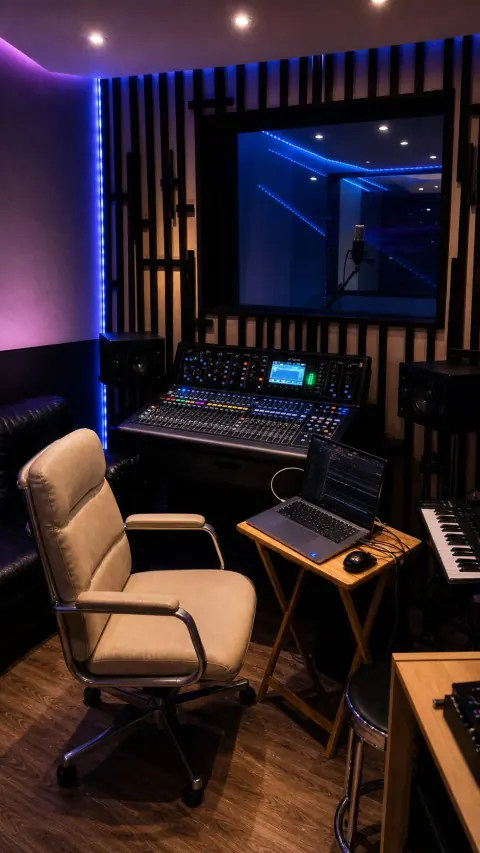
Have it mastered
DJ Studio 37 by ARIA Records masters from your files, so you can send it from anywhere.
$199 to master a song, or $249 for the mix and the master together. Revisions until the direction is right, with no per-round fees.
How it is measured
The same way the services measure your song, and in the same units. The short version of each, in plain words.
What is LUFS?
Loudness Units relative to Full Scale: loudness the way ears hear it, not just how high the wave goes. The sound is weighted the way hearing is (the deep bass counts for less, the upper middle a little more), then averaged over the whole song, leaving out the silent parts. Spotify, Apple Music, YouTube and Tidal all measure a song this way (ITU-R BS.1770) and then turn it up or down to their own level. One LU is one decibel of loudness.
Why does a loud master get turned down?
So that one song is not louder than the next. A master at -8 LUFS is played about 6 dB quieter on Spotify, the same level as a master at -14. It gains nothing in loudness, and if the loudness came from squashing the peaks, it keeps the squashed sound and loses the punch. That is a trade to weigh, not a rule: plenty of club records are mastered loud on purpose.
And a quiet one?
Spotify turns a quiet master up, but only as far as its peaks allow: it keeps them 1 dB under full scale, so a quiet song with loud peaks stays quiet. YouTube never turns a song up at all. Some players, like Spotify's web player, do not change the level either way.
What is true peak, and why -1 dBTP?
The wave between the samples can go higher than the samples themselves. True peak finds it by looking four times closer (4x oversampling), and dBTP is its level against full scale. The services stream encoded files (Ogg Vorbis, AAC, Opus), and encoding adds a little to the peaks, so a master that touches 0 can crackle once it is encoded. Spotify asks for -1 dBTP or lower, and -2 dBTP for a master louder than -14 LUFS.
What counts as clipping here?
A place where the wave sits flat at full scale for three samples or more in a row, in either channel, or goes over it (a 32-bit float WAV or an MP3 can). One sample touching full scale is counted in the peak, not as clipping.
What is the loudness range?
How far the quiet parts sit under the loud ones, in LU (EBU Tech 3342): the loudness 3 seconds at a time, from the quietest tenth to the loudest twentieth, leaving out silence. A heavily compressed pop or EDM master can be under 4; an orchestra can be over 15.
How close is this to my meter?
It follows ITU-R BS.1770 for loudness and EBU Tech 3342 for the range, so on a WAV it should agree with a meter that does the same to within a few tenths. True peak is an estimate in every meter, this one included. An MP3 is measured as your browser decodes it, which can read a little differently from the WAV it came from. Before a release, your mastering engineer's meter is the one that counts.
Are the services' levels right?
As of October 27, 2026. Spotify publishes its level, -14 LUFS, and how it treats peaks. Apple Music, YouTube and Tidal publish no figure, so theirs are what engineers measure: about -16 for Apple Music's Sound Check and about -14 for the other two. Any of them can change, so every level on the reading can be edited, and the rows follow.
Is my song uploaded?
No. Your browser opens the file and measures it on this device. Nothing is sent to us or anyone else, and nothing is kept once you leave the page.
More, free
Learn
The other free tools: what streams pay, a check for any ISRC or barcode, who pays you for each play, and the red flags in a contract.
Open LearnThe handbook
Nine chapters on the money: streams, registrations, contracts, sync, and what you are sold that is free somewhere else.
Open the handbookThe Board
Ask the people who record and release music here. Answered in public, so the next person finds it too.
Ask a question